My New Editor

Google has a concept called “Readability” which usually means you can write and review code of a certain language in the accepted style.  When I first joined Google it seemed bureaucratic but I think it strikes a good balance and the languages I have readability in I feel pretty confident that I can write things that will incorporate the style decisions, and the languages I don’t have it, I don’t have that confidence.  

A couple of months ago I had an idea that this concept might be useful at a higher level.  Instead of Go or TypeScript, what if there was Readability for concepts like security, or maintainability?  I started chatting with AI and eventually ended up on what has been a very enjoyable project.  It’s not “readability for maintainability” like I thought, nor is it about certification or iron-clad rules, but it’s become a growing repository of thoughts, stories, and observations.  I’ll get into more about the process in the future.

I’ve gone back and forth about sharing it here, not because it’s embarrassing but because of the AI aspect.  I think it’s been an absolutely fantastic tool for editing and organizing these thoughts and notes, and prompting me for topics to write on, and I love just being able to write a draft and have it come out as something built a bit better.  Much of it is my words exactly, but rearranged or glued together into a better structure.

So far 100% of this blog, including this post, has been hand-written by me, I’ve used AI to review the past few posts and made some revisions based on feedback but none of it was written by an AI.  I’m now in a position where my choices are to share AI-assisted content, rewrite it myself to satisfy some arbitrary rule, or not share it at all.  I don’t like the last option, and the second option seems kind of foolish, so I’m going with the first one and I’m going to tag these posts as #ai-assist for transparency. Where I’ve only used it for feedback I’ll use #ai-review.

The AI isn’t doing anything a good editor wouldn’t do. All of the thoughts, examples, principles and stories are mine (or credited where due).  To me, that’s not slop.  I hope people judge the content based on what it’s saying rather than the tools involved, but I respect the sensitivity people have towards these tools and don’t want to misrepresent things.

Personal Computing Returns

I’ve been doing a lot of AI-assisted coding both at work and at home lately, and am noticing what I think is a positive trend. I’m working on projects that I’ve wanted to do for a while, years in some cases, but never did. The reason I never did them was because they just didn’t seem like they were worth the effort. But now, as I become a better vibe coder, that effort has dropped rapidly, while the value remains the same. Even further, the value might actually be more, because I can take it even beyond MVP levels and get it to be really useful.

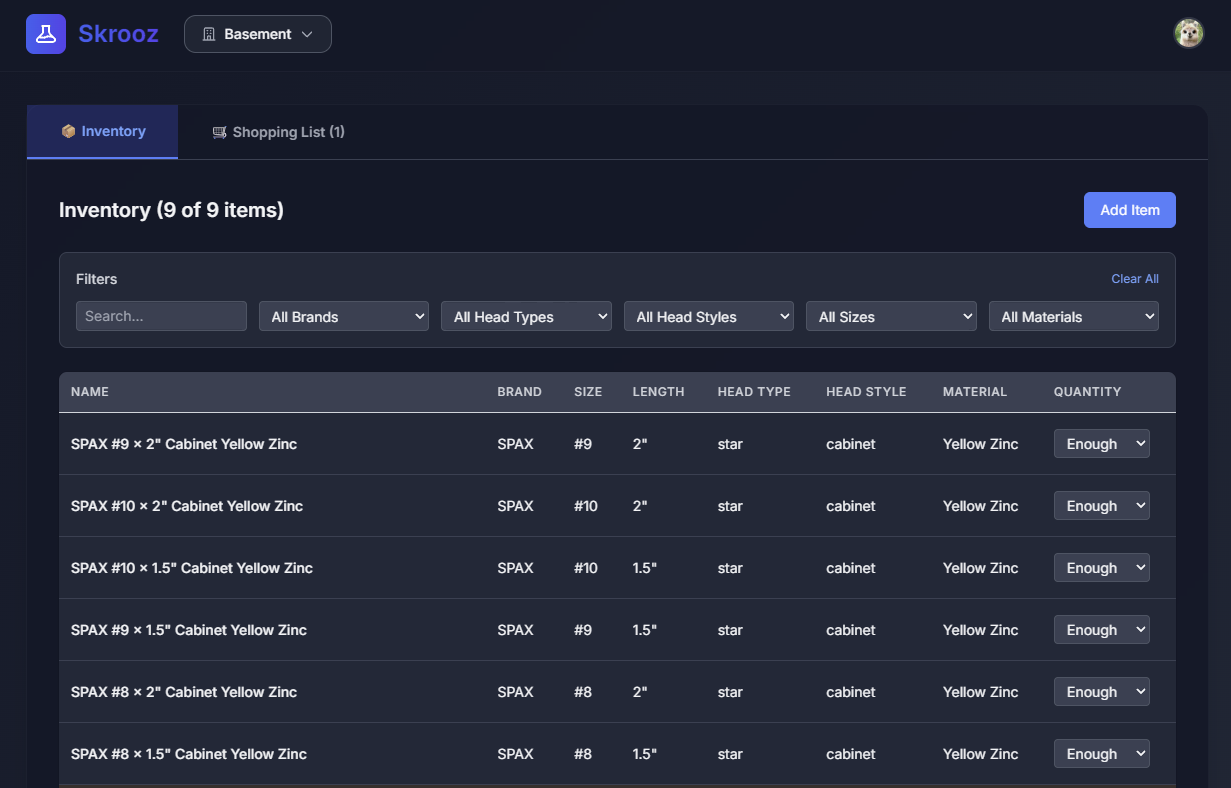
Case in point: I do a lot of DIY renovation work and woodworking (though not enough of the latter). I use a lot of screws and other hardware, and it can be very disruptive to run out. I try to stay organized and restock pre-emptively, but it’s easy to run out. What if there was an app that was purpose-built for tracking this, that made checking and updating inventory as simple as possible, and made it easy to restock? Even better, what if it was written exactly how I track my screws, and had all of the defaults set to the best values for me? Better still, what if it felt like the person who wrote it really understood my workflow and removed every unnecessary click or delay?

Screenshot of a vibe-coded screw inventory app.

Anyone familiar with app development knows that once you get into the domain-specific details and UX polish necessary to take something from good to great, the time really skyrockets. Screws have different attributes than nails, or hinges, or braces, or lumber. People do things in different ways, and if you miss one use case, they won’t use it. If you cover everything, it’s hard to use and doesn’t feel magical for anyone. You could knock out a very basic version in a few nights, maybe 10 hours, but this wouldn’t do much more than a spreadsheet, which is probably what you’ll go back to as soon as you find some bug or realize you need to refactor something. To make this thing delightful you’re likely in the 50-100 hour range, which is maybe in the embarrassing range when you tell your friends you just spent a month of free time writing an app to keep track of how many screws you have in your basement.

With the current crop of tools like Claude Code and Gemini CLI, that MVP takes 20 minutes, and you can do it while watching the Red Sox. Another hour and it’s in production, and starting to accrue some nice-to-have features, even if the Rays played spoiler and beat the Sox. It works great on desktop and mobile, it safely fits on the free tiers of services like Firebase and Vercel so it’s basically maintenance-free. One more hour while you’re poking around YouTube and you’ve got a fairly polished tool you’re going to use for a while.

I think most people probably have a deep well of things they’d like to have, that never made any financial sense, and probably aren’t interesting to anyone else. We’ve probably even self-censored a lot of these things so we’re not even coming up with as many ideas as we could. But when the time/cost drops by 90% or more, and you can take something from good to great, and have it tailored exactly to you, it’s a whole new experience.

The term “personal computing” went out of style decades ago, and now it feels like we’re all doing the same things in the same way with the same apps, but maybe it’s time to start thinking for ourselves again?

Media Diet: July 2025

This entry is part 4 of 6 in the series Media Diet

Books

The Naming Song by Jedediah Berry – I enjoyed this, as did my book club. It was both creative and coherent which can be tough to pull off together. The ending was a bit soft but the story and world building were great. My favorite fantasy stories are the ones that really explore a truly new idea (“What if all words had real power?”), and this did that.

Games

The Planet Crafter – In Progress – I love factory/automation games, and also enjoy base-building/colony games. Planet Crafter has elements of those as well as some things I don’t usually prefer like exploration and even avoid like survival (environmental, not enemies). There are things in the game that would normally be a dealbreaker such as excessively constrained inventory, mission time, and resources, and minimal creative freedom, but I’m still enjoying it. I think the peaceful vibe of bringing a planet back to life is strong enough to make this immersive and rewarding.

Blacksmith Master – In Progress – Another ~automation game, though moreso about optimizing supply and throughput. I’ve only put a couple of hours into it but it’s been fun so far.

Music

Glass Beams – Another discovery in the gap since my last post, this trio is more live-played chill beats than traditional songs but still manages to be more than background music. Pairs well with Khruangbin and a night-time drive.

Theater

Blue Man Group – The whole family went on the last day they were playing in Boston, and it was enjoyed by all. I saw them 20+ years ago and some of the show is unchanged but it still all felt fresh.

Television

Murderbot, Season 1 – A good and faithful adaptation of All Systems Red. Skarsgård plays the title role very well, and the rest of the cast was also great and supported by beefed-up roles for the humans. The production had a sparseness that was reminiscent of a theater play and it fit very well.

Department Q – A decent but not very innovative detective show. Riddled with well-executed cliches like the grumpy detective, plucky assistant and secretly masterful sidekick, it fit my mood when I started and I probably wouldn’t have finished it if it wasn’t a short series, but it wrapped things up cleanly.

Sports

Savannah Bananas – Frequently compared to the Globetrotters (who are also great), but for baseball, I think one thing the Bananas do better is stay truer to the sport. A very kid-friendly environment with music, dancing, pranks, trick plays and a fast-paced game, but it’s still a nominally competitive game at it’s heart.

Sanford Mainers – Our local summer college-level team, heading into the playoffs. Good baseball in its purest form: wood bats, talented players and a local crowd that’s watching every pitch.

Red Sox – They’ve stepped up a bit since last month, highlighted by a 10 game win streak. Postseason chances are looking better. I’m glad they apparently aren’t going to trade Duran, he’s a great player on a number of fronts and having 4 outfielders isn’t a bad thing in today’s injury-plagued game.

In Progress

Lego Masters, Season 5

The Long Way to a Small, Angry Planet (Wayfarers Book 1) by Becky Chambers

Oddsparks: An Automation Adventure

AI

It’s been a long time since my last post about technology, and in the meantime AI happened (again). It’s dominated the conversation, even beyond the tech crowd, since ChatGPT was released. Budgets and strategies at many companies have been massively disrupted echoing earlier booms and bubbles but adding its own unique attributes as well. I’ve got a number of things I’d like to share here and in the future, but I’ll start by saying I’m generally optimistic on this, especially long-term, for a few reasons:

It’s Exciting

I started my career in the “dot com boom”, when the Internet left universities and infiltrated almost every nook and cranny of the economy and people’s lives over the next 10-15 years. There were new developments daily, for years on end, even after the stock market blew up. Disruption and innovation was constant. It felt like a once-in-a-lifetime kind of thing, even in the moment. Nobody expected it to last forever but nobody knew when it would end either.

The AI boom isn’t quite at the same level, but it’s closer than I thought I’d see again. There are new tools and techniques coming out very frequently. There are vast sums of money being invested in many areas. There are new skills to learn, new toys to tinker with, new styles of craft being developed.

One big difference is that during the Internet boom most of the money was going into people. Anyone remotely employable could get a job writing web pages that paid far more than anything else they could do. This time, far more of the money seems to be going into power and compute, in part because that’s an important part but also because there’s a pernicious fixation on automation and displacement rather than the focus on leverage that the Internet fostered. This makes it more of a high-stakes kind of excitement but it’s still excitement.

It’s Important

Since the Internet we’ve seen a number of hype cycles of all sizes offering varying combinations of transformation, enchantment and value. Mobile, social, crypto/blockchain, big data, voice assistants, IoT, VR, 3D printing, smart homes and so on. Most of these are durable but a generation from now they will all be distilled in a few turning points at a cultural level, and the rest will only be remembered as significant within specific industries. I think mobile & social have been truly transformative culturally; they’ve deeply affected politics, friendships, families, and communities. With that one exception I think all of the other trends could be eclipsed by AI’s impact on our lives, economies, and future.

The key vector for that statement is agency. And not in a buzzwordy “agentic” way, but in the sense that vibe coding a TODO app is a tiny taste of the direction things are going. More people are going to be able to do more things, and in a rare violation of deeply held beliefs, they’re going to be able to them better, cheaper and faster. Distributed agency is a massive threat/shift for a global economy that’s been shifting towards services for decades, and it’s going to be a bumpy ride but I think in the end it’s going to be a huge boon. Once more people start to really push boundaries and leave the routine work behind for the robots, we could see an improvement in innovation and new ideas.

This is where the “pernicious fixation on automation and displacement” I mentioned above seems short-sighted and wrong to me. If you have a tool that makes your employees more productive, and you choose to do the same thing with fewer employees, you’re doing it wrong. If you’re running your business properly, your employees should now be making you even more money, so why would you lay them off? I’m not saying this is a trivial change and of course there are lots of details and nuances, but I see far fewer people thinking about growing the metaphorical pie than those who think it’s a fixed size.

It’s Inevitable

This is not the “use AI or become obsolete” pitch that many are making, but more about the fact that it’s here to stay. While the latest and greatest models require billion and trillion dollar companies, the trailing edge of self-hosted/open-source models and systems is keeping up at an impressive pace. Even if OpenAI and Google and Anthropic disappeared tomorrow, we’d still have a large fraction of the capabilities available to us.

“This is the worst it will ever be” is a mantra you might hear from AI fans and I think it’s mostly true. LLMs and RAG and “agents” and whatever FotM we’re excited about now may not be relevant in 10 or 20 years but the thing that will exist will almost certainly be better. We don’t have to use it, and we don’t even have to like it, but we can’t ignore it. If you work with any kind of information and are anywhere but the very end of your career, you should have a plan that addresses, if not includes, AI.

It’s Interesting

Finally, it’s personally relevant to me because it’s just something I think about a lot. Suck.com’s “shiny vs. useful” chart is one I come back to again and again, and AI is both. Not Sun/fire level but still very positive on both of those axes. The fact that it has a huge overlap on my own work in software and tech, and the points I made above, mean this is just too good of a topic to not geek out on. I hope to share more thoughts here in the future on both the positive and negative aspects.