This is a politics-free blog, but this needs to be said. I’ve watched most of the debates since the laughable Clinton/Dole ones, through the confusing Bush/Gore ones, and through the pitiful Bush/Kerry ones, and that was the first real presidential debate I’ve ever seen. Two smart guys going at it (after a bit of prodding by Jim Awesomepants Lehrer), minimal bald-faced-lies, presenting real differences of beliefs and leadership. Maybe this whole democracy thing actually works…
52 Word Review: Hancock
 Hancock is the most under-rated movie of 2008 so far. It’s not great, but it’s pretty good and very fun and likeable. It’s got some actual humor, superhero effects, a few cheesy scenes and lines, and a simple but effective backstory. It also isn’t trying to start a franchise, which is a nice change.
Java Goofs: Enhanced For Loop
One of the “big deals” in Java 5 was the enhanced for-loop. Basically you could trim this:
for(int i=0;i<collection.size();i++) {

     Object object = collection.get(i);

     doSomething(object);

}
down to this:
for(Object object:collection) {

     doSomething(object);

}
I don’t think such an improvement was really necessary, but combine this with generics and I have to admit your code does look a little cleaner, so I use them when possible. However, the for-loop is basically a half-implemented hack with two major goofs.
1. It works with anything implementing Iterable, and arrays. Despite working with anything Iterable, it does not work actual iterators, which seems just silly to me.
2. If the collection is null, it throws a NullPointerException. The only defense I’ve seen for this is that “a null collection is not the same as an empty collection”. Agreed, and those people clearly missed the point. The point was to clean up the code and now we have to add the same silly if(collection==null) around the loop. If your code really did need to know if the collection was null (e.g. lazy-loading), it’s going to check anyways, but this would save at least one more repetitive line if the loop just treated null as empty and did nothing.
Hudson Balloon Festival
 There’s an annual balloon festival in Hudson, MA. The festival itself isn’t much, a dozen or so local vendors, but it happens to be across the street from Reeny, so it’s hard to argue against checking it out. I was somewhat surprised that it seems fairly easy to get one in the air, you roll it out, blow a fan into it, and fire it up when it’s almost ready. I’m sure there are some tricks, but they’re typically launched by just a few people. It was also a good test of one of my new toys, the circular polarizing lens filter, which can really make the blue sky and clouds pop.


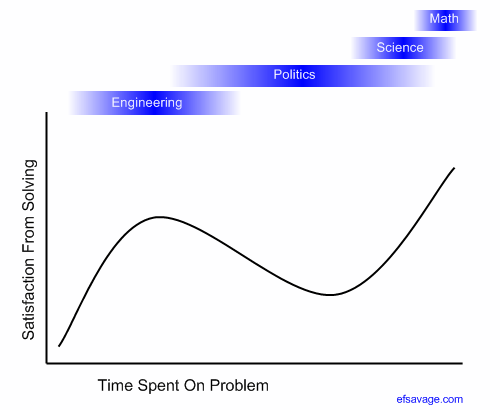
Why I Do What I Do
Browser Games: Tribal Wars
Third in a series on browser-based games. First post here.
I initially checked out Tribal Wars because I saw a few people mention it, and was skeptical because of it’s rather amateurish UI. After giving it a fair shot, however, I have to say it’s probably the most balanced web game I’ve seen to date, and I’m still playing it.
TW is fairly generic in its setting, I’d say loosely medieval. It is very combat oriented, as it’s name implies, and your struggle is not only to stay alive but to expand and improve in a congested world. You can grow somewhat fast if you forgo defending yourself, but that’s rarely wise. The world expands, with new players being added to the outside. Over time this makes the distribution form a kind of donut, with dense areas of newer players on the edge, and sparse areas of powerful veterans inside, often hours or days from the newest players and therefore unlikely to steamroll them.
The UI is useful but not very refined, and there’s a premium (paid) option that makes it even more useful and a little less refined. Combat is predictable and errs on the simple side, not quite RPS, but close. Income gains from expansion are proportional to their cost, and both escalate rapidly, which gives a nice sense of progress.
TW also has the option of playing in a “speed round”, where the game is sped up by a factor of 100-400. This effectively turns the highly diplomatic/political game into a brawl that can be more exciting than I expected a text-based game would be. You can build a town up to completion in hours rather than months, and you can also lose it in minutes if you make a mistake or tempt a more powerful player.
I’ll give TW a big thumbs up and recommend it to anyone looking for an involved, strategic game.
Olympic Gripes
 Michael Phelps is a tremendous athlete. Jarrod Shoemaker is also a tremendous athlete. So why is Phelps is able to compete for 8 medals and get the attention and sponsorships, while Shoemaker can win but one, and you’ve probably never heard of him or know what sport he plays. Do we really need separate medals for the 100m and 200m and 400m butterfly, and yet 2 more for the 100m and 200m freestyle, and more for the individual medley, the breaststroke, and so on. There’s one medal for running 200m. There isn’t a separate medal for running it uphill, or backwards, or with a hat on. There’s only one medal for the grueling triathalon (Shoemaker’s sport), for the entire basketball/softball/soccer tournaments, yet some sports pile them on the same people because the events simply aren’t differentiated enough.
Another gripe I have isn’t Olympic specific, but is definitely in full effect there. Some sports have weight classes, others don’t. It seems like if being bigger is an advantage, they add weight classes, but if being smaller is an advantage (e.g. gymnastics), then there are none. I’m not saying I want to watch the 300lb+ marathon, but if you want to claim you’re the best weightlifter in the world, lift the most weight, period. If you want to claim you’re the best boxer or fighter, take on all challengers or stop adding “pound for pound” disclaimers to your dubious claims.
That said, good luck to all of the athletes, especially the surprising number from Massachusetts!
Browser Games: Ikariam
Second in a series on browser-based games. First post here.
Ikariam is a strategy game, with Roman themed artwork and an ancient/medieval setting. As of this posting, it’s in version 0.2.7, so I guess that means it’s beta/still in developement. I’m still technically active in the game, though active is an overstatement since I basically log in each day to see that it will still be many days before I can grow again.
It probably has the nicest art of any of the browser games, it’s even better than many installable games. Ikariam starts out strong, with fairly rapid build times and cheap expansion, but what might be its fatal flaw develops later on. Expansion costs are exponential, typically doubling or more, while the returns on that investment are meager, 10-20%. This makes the game slow to a crawl after a few weeks. Combat is slow and relatively simple, and there really isn’t any reason to fight someone except to pillage them, which is barely worth the effort.
I’m not sure what the designers were thinking, perhaps there is some unreleased feature that will open the game up, but for now, I’d have to say its a dud.
52 Word Review: Step Brothers
 Ferrell and Reilly redeem themselves for Talledega Nights in this one. Step Brothers starts OK, peaks in hilarity, then falters towards the end, but is the funniest comedy of the year so far. The most immature scene of the movie was also the first to have me in tears in a long time.
Browser Games: Intro
Lately I’ve been exploring the not-new-but-maturing area of BBMMO (“Browser Based Massively Multiplayer Online”) games. They have some cool aspects that drew me to them, and I figured I’d talk a bit about some that I’ve tried in my first-ever series of posts.
These games largely fall into two categories: strategy and role-playing. The role-playing ones are all about you building up a character, typically to compete with other characters. The strategy ones are usually about building up cities and armies and warring with other players or guilds. Both types can be found for all of the standard gaming genres: medieval fantasy/sci-fi/cyberpunk/sports. They also vary widely in terms of competitiveness and social aspects.
Persistence and asynchronicity are defining attributes. They are designed to be played casually, whenever you want. You can attack someone who is not online, or assist a friend on a completely different schedule. This is more like the old play-by-mail games than games like World of Warcraft or Starcraft. Active players often log on several times a day, typically for just a few minutes, and read messages, read reports, launch attachs, issue build orders, etc.
These games typically lack the flair of a downloadable/installable game, or even that of a flash game. Some of them are even almost entirely text-based. They seem to be heavily focused on game mechanics rather than interface, not unlike a board game, and this has a noticeable effect on the type of gamers you’ll encounter. Those lacking patience or the desire to dig deep typically become inactive quickly.
There are hundreds, possibly thousands of these games out there, many with active playerbases in the tens of thousands, yet they are largely ignored by the mainstream gaming community probably because of their lack of commercialization and blockbuster titles. Over the next few days I’ll be discussing some of the ones I’ve tried, including Ikariam, Tribal Wars, Travian, Duels, and Baseball Boss.